10 Inspiring Confidence Quotes for Kids That Spark Self-Acceptance
You yourself, as much as anybody in the entire universe, deserve your love and affection. — Sharon Salzberg
Every child carries within them an extraordinary spark — a unique combination of talents, quirks, and potential waiting to be recognized. Yet in a world filled with social comparison, academic pressure, and the noise of social media, that spark can flicker. This is where confidence quotes step in as surprisingly powerful tools. A single well-chosen sentence can reframe how a child sees themselves, turning self-doubt into curiosity and fear into courage [1].
Whether you’re a parent searching for morning motivation, a teacher building a classroom culture of belonging, or a caregiver trying to support a struggling child, the right words at the right moment can leave a lasting impression. Research consistently shows that the messages children hear — and eventually repeat to themselves — shape their self-concept in profound ways [7].
This article brings together 10 of the most inspiring confidence quotes for kids that genuinely spark self-acceptance, along with practical guidance on how to use them effectively across different ages and settings.
Why Confidence Quotes Matter for Children’s Development
Words are never just words when it comes to children. The phrases kids hear repeatedly become the internal scripts they carry into adulthood. Confidence quotes offer a simple, accessible way to introduce empowering language into a child’s daily environment [1].
Developmental Area
How Confidence Quotes Help
Example Outcome
Emotional Regulation
Provide language for managing self-doubt
Child says “I can try again” instead of “I give up”
The Science Behind Positive Affirmations and Self-Esteem
The connection between affirming language and healthy development is well-supported by psychological research. Self-affirmation theory, developed by psychologist Claude Steele, suggests that reflecting on positive personal values helps protect psychological integrity under stress. When children regularly encounter uplifting messages, these words gradually become part of their internal monologue — the quiet voice that narrates their daily experiences [7].
Neuroplasticity plays a role here too. Young brains are especially receptive to repeated input, meaning that confidence-building messages heard consistently during childhood have a genuine chance of rewiring default thought patterns. Studies on positive affirmations show measurable improvements in self-esteem scores among children who engage with affirming language regularly [4].
This doesn’t mean a single quote transforms a child overnight. Rather, consistent exposure to empowering words builds a cumulative foundation — one that supports healthier responses to setbacks, criticism, and uncertainty [6].
How Words Shape a Child’s Inner Dialogue
By around age seven, most children have developed a stable inner voice — a running commentary on their own actions and worth. The content of that inner voice is heavily influenced by the language they’ve absorbed from caregivers, teachers, and their broader environment [7].
When a child repeatedly hears phrases like “Believe in yourself” or “Mistakes help you grow,” those ideas eventually migrate inward. They stop being external encouragements and become self-generated beliefs. Conversely, children exposed to critical or dismissive language tend to develop harsher inner critics that are difficult to silence later in life [4].
This is why intentionally surrounding children with positive language — through quotes, affirmations, stories, and everyday conversation — is considered a meaningful act of emotional investment. The words we offer children today become the thoughts they think tomorrow [9].
10 Inspiring Confidence Quotes for Kids That Spark Self-Acceptance
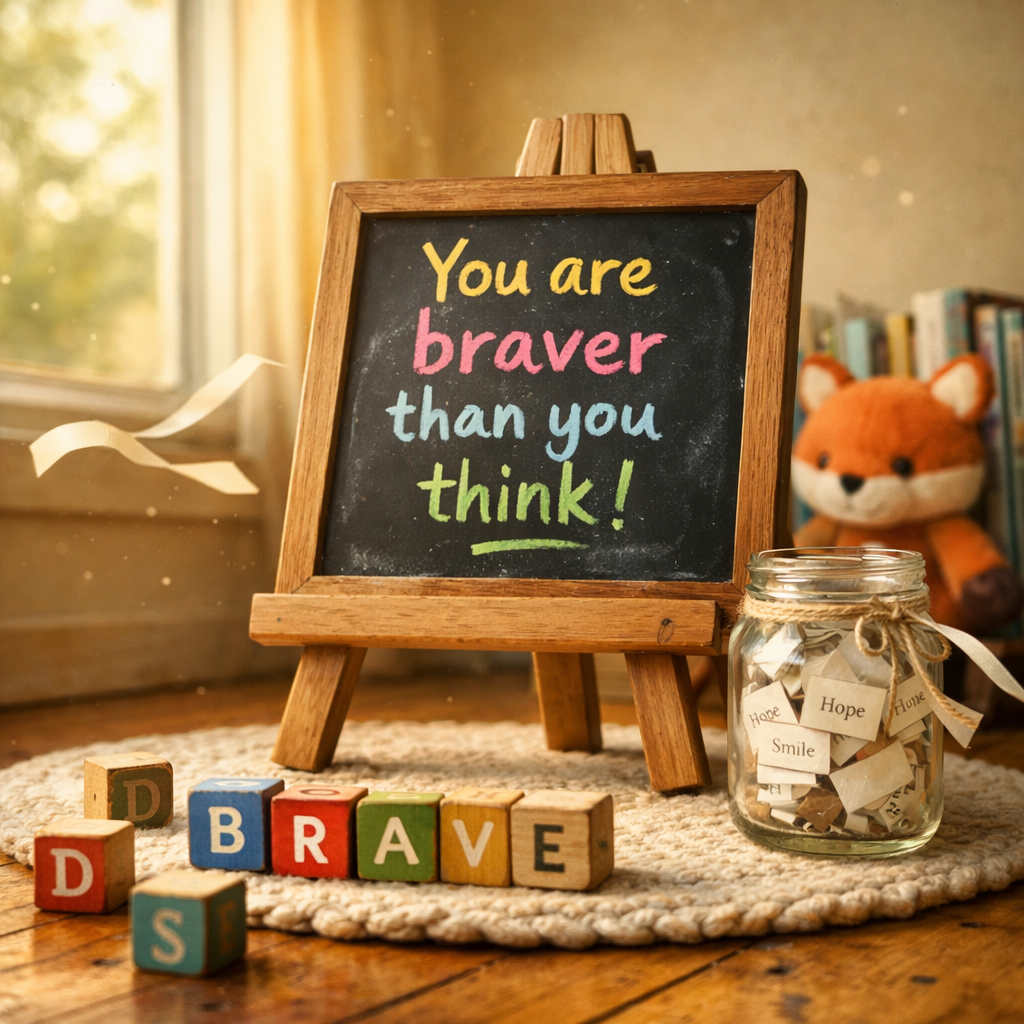
You are braver than you believe, stronger than you seem, and smarter than you think. — A.A. Milne
Few collections of words have resonated with children and parents alike as deeply as this beloved reminder from Winnie-the-Pooh. It captures something essential: that children often underestimate themselves, and that a gentle, loving nudge toward self-belief can change everything [1].
Quotes About Embracing Uniqueness and Being Yourself
Some of the most powerful confidence quotes for kids are those that celebrate individuality rather than conformity. Children thrive when they feel seen and valued for exactly who they are [2].
“Today you are you, that is truer than true. There is no one alive who is youer than you.” — Dr. Seuss. This playful line affirms that uniqueness is not a flaw but a gift [1].
“Why fit in when you were born to stand out?” — Dr. Seuss. A bold reminder that self-expression is worth protecting.
“Love yourself first and everything else falls into line.” — Lucille Ball. A foundational truth that resonates even with younger children when explained simply [1].
“The greatest thing in the world is to know how to belong to oneself.” — Michel de Montaigne. A deeper quote suited for older kids exploring personal identity [5].
Quotes About Courage, Mistakes, and Growing Stronger
Building genuine confidence also means helping children reframe failure. These quotes teach that resilience is built through effort, not perfection [3].
“It always seems impossible until it’s done.” — Nelson Mandela. Encourages children to push past initial resistance [8].
“Believe in yourself! Have faith in your abilities!” — Norman Vincent Peale. A direct, energizing call to self-trust [9].
“You did not wake up to be mediocre.” — Robin Arzón. Short, punchy, and memorable for older kids [3].
“Fall seven times, stand up eight.” — Japanese Proverb. Teaches that perseverance defines character more than outcomes [10].
“I am, I can, I will, I do.” — Peloton instructor Robin Arzón. A four-part affirmation children can memorize and repeat [3].
“You gain strength, courage, and confidence by every experience in which you really stop to look fear in the face.” — Eleanor Roosevelt. A timeless reminder that courage grows through action, not avoidance [6].
How to Use Confidence Quotes Effectively With Kids
Knowing which quotes resonate is only half the work — the other half is intentional delivery. A quote posted on a refrigerator and never discussed has far less impact than one woven naturally into a moment of struggle or triumph. Here are the most effective ways to introduce confidence quotes into a child’s world [1]:
Read a quote aloud together during breakfast and ask, “What do you think this means for you today?”
Write a quote on a sticky note and place it inside a lunchbox as a midday reminder.
Use a quote as a conversation starter after a difficult moment, such as a failed test or a social conflict.
Encourage children to choose their own favorite quote and explain why it speaks to them.
Incorporate quotes into bedtime routines by pairing them with a brief reflection on the day’s challenges [9].
Create a family quote jar where everyone contributes meaningful phrases to draw from each week.
The goal is always connection, not correction. When a child feels heard first, an empowering quote lands as support rather than as a lecture [7].
Making Quotes Part of Your Daily Routine
Consistency is what transforms a quote from a one-time inspiration into a genuine belief. Embedding confidence quotes into predictable daily moments — mornings, mealtimes, commutes — helps children encounter them repeatedly without feeling forced [4]. Over time, these phrases become automatic retrieval cues, surfacing naturally when a child faces self-doubt. Even a 30-second morning ritual of saying one quote aloud can meaningfully shift a child’s emotional baseline before the school day begins [6].
Creative Ways to Display and Reinforce Positive Messages
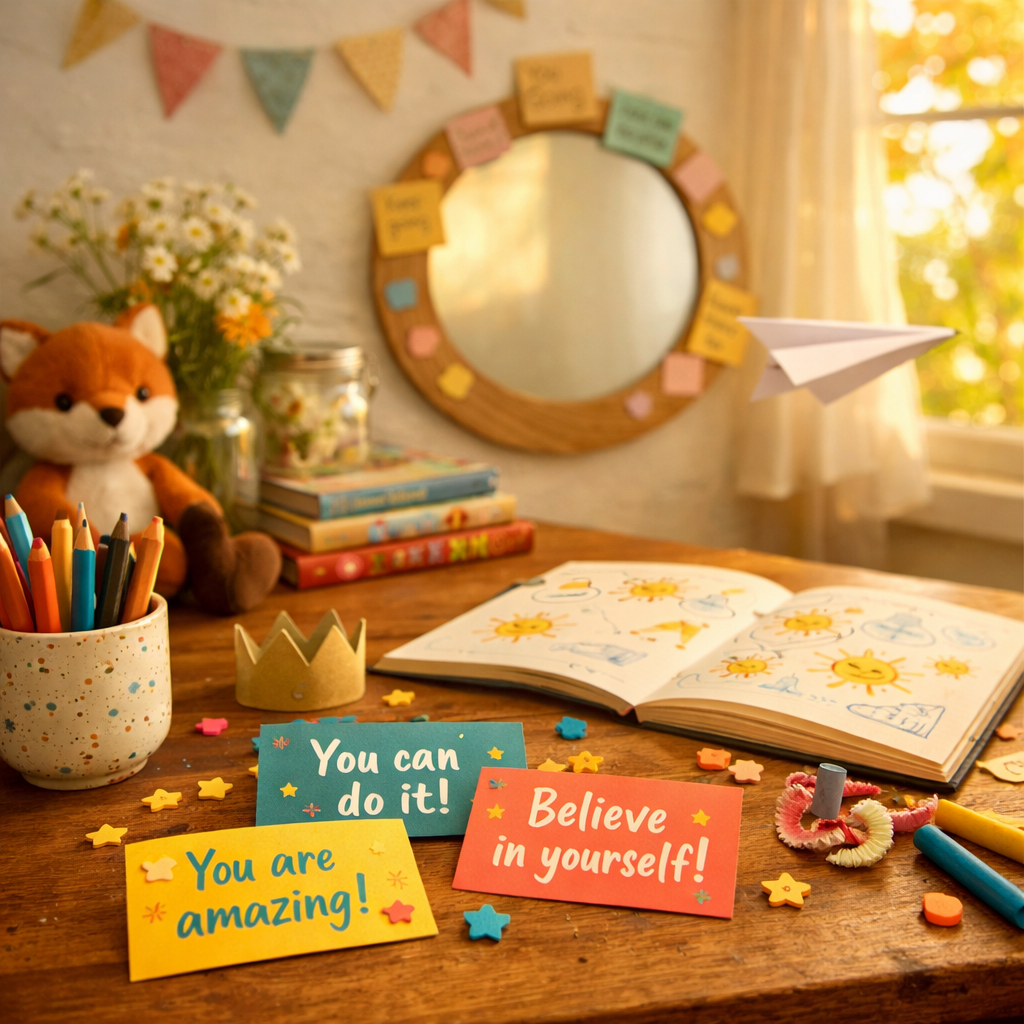
Visual reinforcement extends the life of any quote far beyond the moment it’s spoken. Consider these display strategies that keep confidence messages active in a child’s environment:
Chalkboard walls in bedrooms or playrooms where quotes rotate weekly
Framed prints using tools like Adobe Express to turn favorite quotes into personalized artwork [5]
Vision boards where children pair confidence quotes with images that represent their goals
Classroom quote corners where teachers feature a new quote each Monday for group discussion [2]
The more a child sees and interacts with a message, the more deeply it embeds into their self-narrative [7].
Age-by-Age Guide to Sharing Confidence Quotes
Not every quote works for every age. A phrase that resonates deeply with a ten-year-old may be too abstract for a five-year-old, and too simple for a teenager. Matching the complexity and emotional tone of a quote to a child’s developmental stage makes a measurable difference in how well it lands [1].
Age Range
Recommended Quote Style
Example Quote
Delivery Method
Ages 3–5
Short, rhyming, playful
“Today you are you, that is truer than true.” — Dr. Seuss
Read aloud during storytime
Ages 6–8
Simple, action-oriented
“You are braver than you believe.” — A.A. Milne
Morning mirror ritual
Ages 9–11
Growth-focused, relatable
“Fall seven times, stand up eight.” — Japanese Proverb
Discussion after setbacks
Ages 12–14
Bold, identity-affirming
“You did not wake up to be mediocre.” — Robin Arzón
Journal prompts or phone wallpaper
Ages 15–18
Philosophical, aspirational
“The greatest thing in the world is to know how to belong to oneself.” — Montaigne
Independent reflection or class discussion
Developmental appropriateness matters because children process language through the lens of their current cognitive and emotional capacity [6]. A quote that feels empowering to an adult may feel confusing or even pressuring to a young child if it isn’t introduced with context [9].
Scaffolded conversations — where a caregiver helps a child unpack the meaning of a quote step by step — are especially effective for the 6–11 age range, when children are building metacognitive awareness but still benefit from guided interpretation [4]. For teenagers, giving them ownership over which quotes they connect with tends to produce stronger results than assigned phrases [3].
What Experts Say About Building Confidence in Children
The research community has long recognized that confidence is not a fixed trait children either have or don’t — it is a cultivated skill shaped by environment, language, and relationship. Psychologists and educators consistently point to the power of affirming language as one of the most accessible tools available to parents and teachers [7].
Confidence is not ‘they will like me.’ Confidence is ‘I’ll be fine if they don’t.’ — Christina Grimmie
This distinction — between approval-seeking and genuine self-assurance — is central to what experts emphasize. True confidence, researchers argue, grows not from constant praise but from supported challenge: allowing children to struggle, fail, and recover within a relationship that consistently affirms their worth [4].
The Role of Parents and Teachers in Reinforcing Self-Belief
Adults serve as the primary architects of a child’s self-concept, which means their words carry disproportionate weight [7]. Research from positive psychology suggests that children who regularly hear specific, genuine affirmations from trusted adults develop stronger internal locus of control — the belief that their actions genuinely influence outcomes [6].
Teachers who post confidence quotes in classrooms and reference them during teachable moments report that students are more willing to take intellectual risks, ask questions, and persist through difficulty [1]. Parents who model self-compassionate language at home — including sharing their own struggles alongside affirming quotes — give children permission to be imperfect while still believing in themselves [9]. The combination of consistent language, emotional safety, and meaningful relationship is what expert consensus identifies as the true engine of lasting confidence in children [4].
Signs That Confidence Quotes Are Making a Difference
How do you know whether the confidence quotes you’re sharing are actually taking root? Children rarely announce, “That quote changed my thinking.” Instead, the shifts tend to be behavioral and gradual — small but meaningful changes that accumulate over weeks and months [1]. Watching for these signs helps caregivers and teachers gauge whether their efforts are having the intended effect and adjust their approach as needed.
Your child begins using affirming language unprompted, such as saying “I can figure this out” or “Mistakes help me learn” during moments of frustration [7].
They show increased willingness to try new things, including activities where failure is likely, without immediately shutting down or seeking reassurance [4].
You notice a reduction in harsh self-criticism — phrases like “I’m so stupid” or “I can’t do anything right” become less frequent and less intense over time [6].
The child starts referencing specific quotes they’ve encountered, applying them to real situations in conversation or journaling [1].
They demonstrate greater resilience after setbacks, recovering more quickly from disappointment, social conflict, or academic difficulty [9].
Their body language shifts — more eye contact, upright posture, and willingness to speak up in group settings signal growing internal confidence [3].
They begin encouraging peers or younger siblings with affirming language, reflecting the internalization of messages they’ve received [7].
These signs don’t all appear at once, and progress is rarely linear. Some children respond quickly; others need months of consistent exposure before visible change emerges [4]. The important thing is to keep the environment rich with affirming language and to celebrate small shifts as genuine victories on the road to lasting self-belief [9].
Conclusion
Confidence is not something children either have or lack — it is something they build, one experience and one affirming word at a time. The confidence quotes explored throughout this article are more than feel-good phrases. They are linguistic anchors that help children return to a sense of worth when the world feels overwhelming [1].
Whether you choose a playful Dr. Seuss rhyme for a five-year-old or a philosophical Montaigne reflection for a teenager, what matters most is the intention behind the delivery — the message that this child is seen, valued, and capable [5]. Pair quotes with genuine conversation, creative display, and consistent routine, and you create an environment where self-acceptance can genuinely take root.
Start small. Choose one quote. Share it today. The ripple effects may last a lifetime [7].
Frequently Asked Questions
How often should I share confidence quotes with my child?
Consistency matters more than frequency. Introducing one quote per week and revisiting it throughout that week tends to be more effective than overwhelming a child with new phrases daily [1]. The goal is for the quote to become familiar enough that the child begins using it independently, which typically requires multiple exposures in different contexts [4].
Can confidence quotes replace professional support for children with low self-esteem?
No — confidence quotes are a supportive tool, not a clinical intervention. For children experiencing significant anxiety, depression, or deeply rooted self-worth issues, professional support from a licensed child psychologist or counselor is essential [6]. Quotes work best as a complementary layer within a broader environment of emotional safety, genuine relationship, and appropriate challenge [7].
What if my child rolls their eyes or resists motivational quotes?
Resistance is common, especially among older children and teenagers who may perceive quotes as preachy or performative [3]. The most effective response is to back off the direct delivery and instead model the language yourself — share quotes that resonate with your own experiences rather than prescribing them. Giving children ownership over choosing their own quotes also dramatically increases buy-in [9].
Are there confidence quotes specifically designed for children with learning differences?
While most quotes are universal, children with learning differences such as dyslexia or ADHD often respond especially well to quotes that normalize struggle and reframe effort as the measure of success [8]. Phrases like “Fall seven times, stand up eight” or “It always seems impossible until it’s done” speak directly to the experience of working harder than peers — and finding strength in that journey [1].
At what age can children start benefiting from confidence quotes?
Children as young as three years old can benefit from simple, rhythmic quotes delivered through storytime and song [1]. Even if full comprehension isn’t present, the emotional warmth and repetition of affirming language begins shaping neural pathways associated with positive self-regard well before children can articulate what a quote means [4].





Leave a Reply